
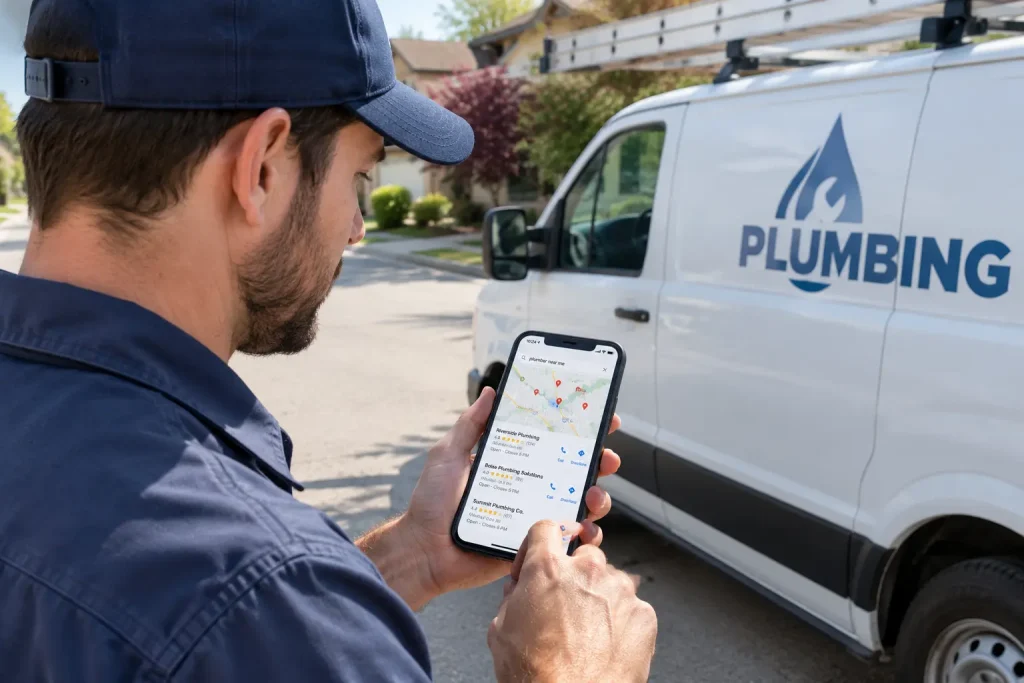
It is 11:40 on a Sunday night. Water is spreading across a kitchen floor, the shutoff valve will not turn, and a homeowner is holding a phone with wet hands. They are not browsing. They type “emergency plumber near me” and call whoever looks most trustworthy in the first three results.
If that business is not yours, you lost a job you never knew existed. That is the entire case for local SEO for plumbers. You do not need to beat every plumber in the country. You need to be the most visible, believable option for people within your service area at the exact moment they need help.
This guide walks through how plumbers actually get found on Google, what customers are thinking when they search, and the steps that move you into the map pack. It is written for owner operators and small crews who want results without becoming marketing experts, and it comes from the hands on approach of Iqra Shakeel SEO Specialist, who builds search friendly content for local service businesses.
Why Plumbers Win or Lose on Local Search
Plumbing has features that make local search unusually powerful.
Urgency. Many searches happen during a leak, a backed up drain or a dead water heater. The customer wants speed and certainty, not a long comparison.
Geography. Plumbers travel to customers. Your service radius defines your market, and your competition is the handful of plumbing companies in that radius.
Trust. A stranger is about to enter a home and quote a price for something they do not understand. Reviews, photos, licensing and clear pricing carry more weight than clever slogans.
Phone first behavior. A large share of plumbing leads call straight from the map listing without ever visiting a website.
Google’s local ranking weighs relevance, distance and prominence, so the playbook is simple to describe even if it takes steady effort to execute.
| Ranking Factor | What It Means in Plain Language | What You Control |
| Relevance | How well your profile matches the search | Categories, services, website content |
| Distance | How close you are to the searcher | Accurate address or service area setup |
| Prominence | How well known and trusted you are | Reviews, citations, links, mentions |
You cannot change where a customer is standing. You can improve the other two factors, and that is where most of your gains come from.
What Your Customer Is Thinking (And How to Answer It)
Strong plumber SEO starts with the mindset behind the search. Most customers carry the same worries.
• “Will they actually show up, and how fast?” Answer with clear service hours, response times and an honest emergency policy.
• “Am I about to get overcharged?” Answer with upfront estimate language and example price ranges.
• “Can I trust this person in my house?” Answer with real photos, licensing details and recent reviews.
• “Is this a big problem or a small one?” Answer with short guides on common issues so they feel informed.
• “Do they cover my neighborhood?” Answer with specific service area pages and a clear list of towns.
Every tactic below is a way of answering one of these questions before the customer has to ask it.
Local SEO for Plumbers Starts With Your Google Business Profile
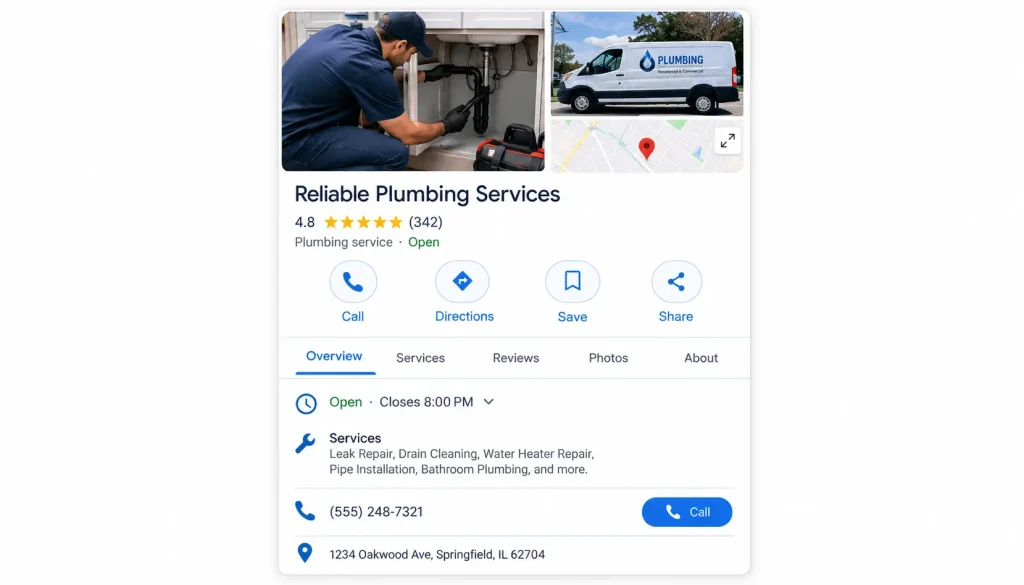
Your Google Business Profile is the free listing that appears in Google Maps and the local pack. Optimizing it is widely treated as the single highest impact action a plumber can take. If you do only one thing from this article, do this.
How to Optimize Google Business Profile
Claim and Verify
Search for your business on Google, claim the listing and complete verification. Unverified profiles have limited visibility and limited control. If someone else created a listing for your business, claim that one instead of making a duplicate.
Choose the Right Categories
Your primary category should be “Plumber” for most companies. Secondary categories help you match narrower searches. Depending on what you actually do, consider options such as drain cleaning service, water heater installation service or septic system service. Only add categories you truly offer. Adding extras you do not perform can backfire.
Decide Between Storefront and Service Area
Most plumbers work at customers’ homes. Setting up as a service area business matches how Google expects plumbers to operate. If you work from a home office, hide your address and list the cities or zip codes you cover. Listing a huge area will not make you rank everywhere. Distance still matters, so be realistic and list the places you can reach quickly.
Fill In Every Field
A complete profile outperforms a thin one. Add:
• A business description written for humans, naming your main services and area
• A full services list with short descriptions (leak repair, water heater replacement, drain cleaning, repiping, fixture installation)
• Accurate hours, including emergency availability if you offer it
• A local phone number (customers trust a local area code)
• Attributes that apply to you, such as being licensed and insured
• Booking or quote links
Photos That Build Trust
Customers want proof you are real. Upload photos of your van, your team in uniform, finished work, tidy workspaces and before and after shots. Avoid generic stock images. Add new photos regularly, since regular activity signals that the profile is active.
Post Updates
Use posts for seasonal tips (freezing pipe warnings, water heater checks before winter), offers and completed jobs. A couple of posts per month is a realistic pace for a busy crew.
How the Google Map Pack Decides Which Plumber Shows Up First
The map pack is the block of three business listings that appears above the regular results when someone searches for a plumber. It is powered by Google Maps data, and it is where most urgent plumbing calls come from. Understanding how it chooses winners helps you stop guessing and start fixing the right things.
Google looks at three signals together.
Proximity. The distance between the searcher and your business location, or the service area you defined. A homeowner on the east side of town will often see east side plumbers first. You cannot move your customers, but you can make sure your address or service area is accurate, so Google never places you in the wrong part of town.
Relevance. How closely your profile and website match the search. A profile with the correct primary category, a detailed services list and a website page for each service gives Google clear evidence that you handle that exact problem. Searches like “water heater repair” or “drain cleaning service” favor businesses that spell those services out.
Prominence. How well known and trusted your business appears across the web. Review quantity, review quality, citations on trusted directories, local backlinks, brand mentions and even your website’s overall authority all contribute.
A useful way to think about it: relevance gets you considered, proximity narrows the field and prominence breaks the tie.
Why Your Competitor Outranks You (Even When You Are Better)
Plumbers often feel frustrated when a company with worse workmanship ranks higher. In most cases the difference is one of these:
- They have more recent reviews, even if their average rating is similar
- Their profile has more categories, services and photos filled in
- Their website has dedicated pages for services and neighborhoods
- Their business name, address and phone number match across more directories
- Their office sits closer to the center of the search area
- They answer reviews and update their profile consistently
The good news is that four of those six are within your control this month.
Quick Map Pack Checklist
| Signal | Quick Win | Longer Term Win |
| Relevance | Add every real service to your profile | Build one website page per service |
| Proximity | Correct your address or service area | Add location pages for key neighborhoods |
| Prominence | Ask for reviews after every job | Earn local links and mentions |
Keyword Research for Plumbers: What People Actually Search
Plumbing searches fall into predictable groups. Build your pages around them.
| Intent Type | Example Search | Best Page Type |
| Emergency | emergency plumber near me, burst pipe repair | Emergency service page |
| Service specific | water heater replacement, drain cleaning | Individual service pages |
| Location specific | plumber in [city], plumber [neighborhood] | Location pages |
| Problem based | why is my water pressure low | Blog guides |
| Cost based | how much does a plumber cost | Pricing guide |
Use Google’s autocomplete, the “People also ask” box and Search Console queries to find the exact wording your customers use. Search Console and autocomplete are free ways to identify the queries people use to find plumbers in your area. Then confirm search volume in a keyword tool before you commit to a topic.
A practical tip: low competition opportunities often hide in neighborhood and problem based searches. Few plumbers write about “slab leak signs” or “sewer smell in the bathroom,” yet homeowners search those phrases daily.
Build a Website That Supports Your Map Ranking
Your Google Business Profile gets attention, but your website supplies the evidence behind it. A map listing without a strong site behind it is like a van with no engine.
Create One Page Per Service
Do not cram every service onto one page. Give each major service its own page: leak repair, water heater installation, drain cleaning, sewer line repair, repiping, fixture installation. Each page should explain the problem, the process, typical timelines, what affects cost and a clear call to action.
If you also deal with the water supply side of household equipment, a related water heater and water line service page can strengthen your topical depth and give readers a natural next step.
Create Location Pages That Are Not Copy and Paste
A location page should earn its place. Mention real neighborhoods, common housing types, local water conditions, typical issues in older homes versus new builds and projects you have completed nearby. Swapping a city name into identical text does not help and can look spammy.
Service area SEO means ranking across every neighborhood and zip code you serve, not just the block where your van is parked.
If you serve the Wylie area, our Wylie appliance repair service area page shows how a location page can combine real details with clear contact options.
Make Calling Effortless
On mobile, put a tap to call button in the header and keep it visible while scrolling. Add a short form for non urgent requests. Mention your service hours near the top. A visitor in a hurry should never hunt for a phone number.
Speed and Mobile Experience
Most plumbing searches happen on phones. Compress images, avoid heavy sliders and test your pages on a mid range phone over a mobile connection. A slow page loses the urgent customer in seconds.
Add Structured Data
Schema markup helps Google read your business details directly. LocalBusiness and Plumber schema are commonly recommended for this. Include your name, phone number, service area, hours and services. Google publishes documentation on how to format this in its local business structured data guidelines.
Citations and NAP Consistency
A citation is any mention of your business name, address and phone number on another site. Examples include the Better Business Bureau, your local chamber of commerce and Facebook. Google compares these listings to confirm your business is real and where you say it is.
The rule is consistency. If your Google profile says “Street” and another directory says “St.,” or your phone number differs between listings, the mismatch can create confusion. Even small formatting differences can confuse Google and hurt local rankings.
A practical audit takes an hour:
• Search your business name and phone number on Google
• List every directory, social profile and listing that appears
• Fix any differences in name, address, phone or website
• Remove duplicates
• Add missing high quality listings
Once your listings are consistent, look at where you appear and how complete each profile is. Start with the big platforms such as Google, Bing, Apple Maps, Yelp and Facebook, then add trade directories and local business sites that fit plumbing. Every listing should carry the same business name, the same phone number and the same website link, with your real services and service area filled in. A short local SEO citation tips guide from Ahrefs explains how citations support your local visibility and which listing types are worth your time. Check each profile every few months, because old phone numbers and closed duplicate listings quietly weaken your trust signals.
Reviews: The Strongest Trust Signal You Control
For plumbers, reviews are often the deciding factor. Customers scan star ratings, read the most recent comments and look for mentions of punctuality, honesty about pricing and cleanliness.
How to Get More Reviews
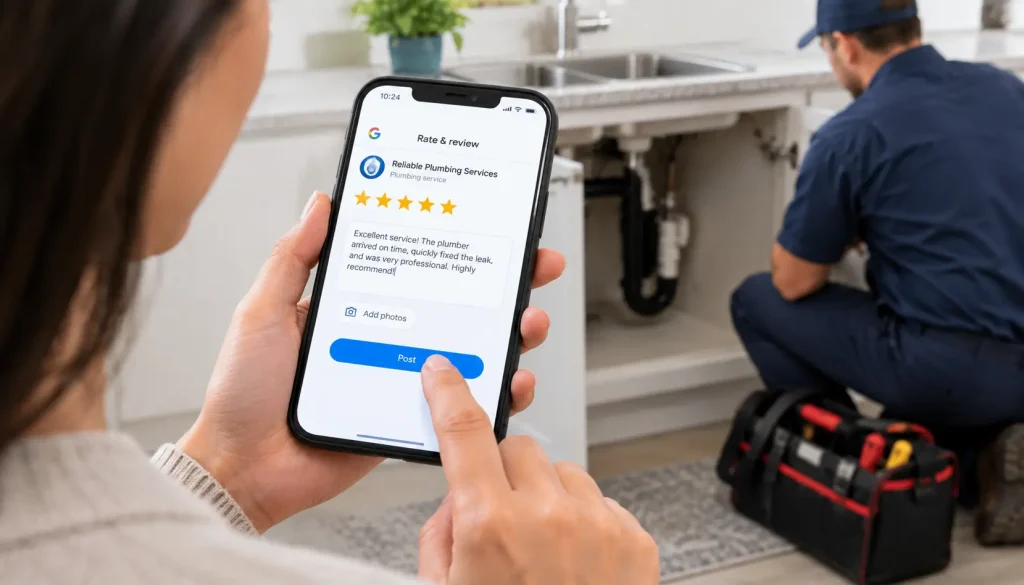
A short text or email with a direct link to your Google profile makes it easy for customers to leave feedback. Build the habit into every job:
• Ask while the customer is relieved and the problem is solved
• Send the link by text within a few hours
• Make it one tap, not a search
• Ask every customer, not only the happy ones you hand picked
How to Respond
Reply to every review, positive and negative. Thank customers by name and mention the service when appropriate. For a complaint, respond calmly, acknowledge the issue and offer to resolve it offline. Potential customers read your replies as closely as the complaint itself. A professional response to a bad review can build more trust than a perfect record with no replies.
What Not to Do
Do not buy reviews, offer discounts in exchange for reviews or review your own business. Google’s policies prohibit fake and incentivized reviews, and violations can lead to removal of reviews or suspension. You can read the rules in Google’s Business Profile guidelines.
Content That Answers Customer Questions
Content turns a plumber into the local expert. A customer who learns something from your guide arrives at your service page already trusting you.
Good topics for plumbing blogs:
• How to find and shut off your main water valve
• Signs of a hidden leak (rising water bill, damp walls, musty smell)
• Why your water heater makes popping sounds
• What drain cleaning costs and what affects the price
• How to prepare pipes for freezing weather
• When to repair and when to replace a water heater
• What to do in the first 10 minutes of a burst pipe
Write each guide so it can be understood by a stressed reader skimming on a phone. Put the direct answer in the first two sentences, then expand. This also helps with answer engine results, where Google and AI tools lift short, clear answers.
Add a clear next step to every guide: “If you cannot find the shutoff or the water will not stop, call us now.”
Building Topical Authority With Plumbing Subjects and Entities
Google does not judge a plumbing website by one page. It looks at whether your site covers the whole subject the way a real expert would. This is called topical authority, and it grows when your content connects related services, problems and terms into a clear web of pages.
Think of your site as a hub with clusters around it. Each cluster has one main service page and several supporting guides.
Topic Clusters Every Plumbing Site Should Cover
| Cluster | Main Page | Supporting Content Ideas |
| Leak detection and repair | Leak repair service | Slab leak signs, hidden leak detection, burst pipe steps |
| Water heaters | Water heater repair and replacement | Tank vs tankless water heater, sediment buildup, pilot light problems |
| Drains and sewers | Drain cleaning and sewer line repair | Hydro jetting, clogged drain causes, sewer camera inspection |
| Pipes and repiping | Repiping service | Copper vs PEX piping, galvanized pipe problems, low water pressure |
| Fixtures and appliances | Fixture installation | Garbage disposal repair, toilet repair, faucet replacement, water softener setup |
| Emergency service | Emergency plumber page | Shutting off the main valve, frozen pipes, flooded basement response |
| Preventive care | Maintenance plans | Annual inspection checklist, backflow testing, winter pipe protection |
Vocabulary That Signals Expertise
Natural, accurate vocabulary shows Google and readers that you know the trade. Use these where they truly fit, never as a forced list:
- Water supply line, shutoff valve, main water line, pressure regulator
- Drain line, P trap, cleanout, sewer lateral, trenchless sewer repair
- Copper pipe, PEX, PVC, galvanized steel
- Water heater anode rod, expansion tank, tankless water heater
- Backflow prevention, sump pump, hard water, mineral scale
- Licensed plumber, master plumber, building code, permit, inspection
Questions That Build Authority
Support each cluster with pages answering the questions real people ask:
- Why is my water bill suddenly higher?
- Why does my hot water run out quickly?
- How do I know if a pipe is leaking inside a wall?
- What causes low water pressure in one faucet?
- Do I need a permit to replace a water heater?
- Is it worth repairing an old pipe or replacing it?
Link the Cluster Together
Connect each supporting guide to its main service page, and link related service pages to each other. For example, a guide on water heater noises should link to your water heater repair page. This helps Google see the relationship between pages and helps readers move toward booking.
If your website also covers related home equipment and service topics, link to those pages where they genuinely help the reader. Appliances that connect to water lines, such as washers, dishwashers and ice makers, are a natural bridge for plumbing content.
Answer Engine Optimization for Plumbing Questions
More searches end with an answer shown directly on the results page or inside an AI summary. To be the source of that answer:
• Start sections with the question as a heading
• Give a direct answer in one to three sentences
• Follow with details, steps or a list
• Use consistent terms for the same thing (water heater, not a mix of water heater, hot water tank and boiler)
• Include real numbers and ranges where you can
Link Building and Local Mentions
Links from local sources signal that real people in your community know your business. These backlinks signal credibility in your community. Realistic opportunities:
• Local chamber of commerce membership
• Sponsoring a youth team or school event
• Partnering with realtors, property managers and home inspectors
• Local news features when you share seasonal tips (frozen pipe warnings)
• Supplier and manufacturer directories that list certified installers
• Local business associations and trade groups
Quality beats quantity. A handful of relevant local links outperform dozens of random directory submissions.
Local Services Ads for Plumbers: Should You Pay for the Top Spot?
Organic ranking takes months. Some plumbers need calls sooner, especially when they are launching a business or entering a new area. That is where Local Services Ads come in. These are the ads that sit above the map pack, usually with a Google Guaranteed or Google Screened badge, and they charge per lead rather than per click.
How They Differ From Regular Google Ads
| Feature | Local Services Ads | Standard Search Ads |
| Where they appear | Top of results, above the map pack | Below or above results as text ads |
| Pricing model | Pay per lead | Pay per click |
| Trust badge | Google Guaranteed or Screened | None |
| Setup | Business verification and background checks | Campaign and keyword setup |
| Best for | Urgent, high intent jobs | Broader promotion and specific offers |
What Verification Involves
Google typically checks your business license, insurance and background information before showing the badge. For a plumber, that paperwork is already part of running a legitimate business, so the badge can be a strong trust signal for nervous homeowners. Requirements vary by location, so check the current rules for your state and service type on Google’s official page before applying.
When Ads Make Sense, and When They Do Not
Ads make sense when:
- You are new and have few reviews
- You want calls during a slow season
- You are testing a new service area
- You have a strong call handling process to convert leads
Ads are a poor fit when:
- Nobody reliably answers the phone
- Your profile is incomplete or has a low rating
- You rely on them and ignore organic work
The smart approach is to treat ads as a bridge. Use them to generate early jobs and reviews while your organic presence grows, then reduce spending as the map pack brings steady calls. Dispute any lead that is clearly irrelevant, such as a wrong service or an out of area request, so you are not paying for it.
Handling Calls: Where Ranking Becomes Revenue
Plenty of plumbers climb the rankings and then lose the job on the phone. Calls that go to voicemail, long hold times and unclear pricing talk send customers to the next listing.
• Answer or return calls quickly, especially for emergencies
• Use a local number or tracking number that forwards to your main line
• Train whoever answers to ask the address, the problem and whether water is actively leaking
• Offer a clear arrival window
• Explain the diagnostic or service fee before the visit
A missed call at 9 PM can cost more than a month of ads.
What Local SEO Costs and What to Expect
Costs vary by market, so treat these as planning ranges and check them against quotes in your area.
| Approach | What You Pay With | Typical Effort | Speed of Results |
| Do it yourself | Time | Several hours a week at first | Slowest, but low cost |
| Freelancer or consultant | Monthly fee or project fee | Hands on guidance | Moderate |
| Local SEO agency | Monthly retainer | Mostly done for you | Moderate to fast with a clear strategy |
| Paid ads (for comparison) | Cost per click | Ongoing budget | Immediate, stops when spending stops |
Many guides say meaningful results take about three to six months. Profile fixes can show movement within weeks, while competitive markets can take longer. Treat local SEO as an asset that compounds. Ads rent attention, while ranking builds something you keep.
Track What Matters
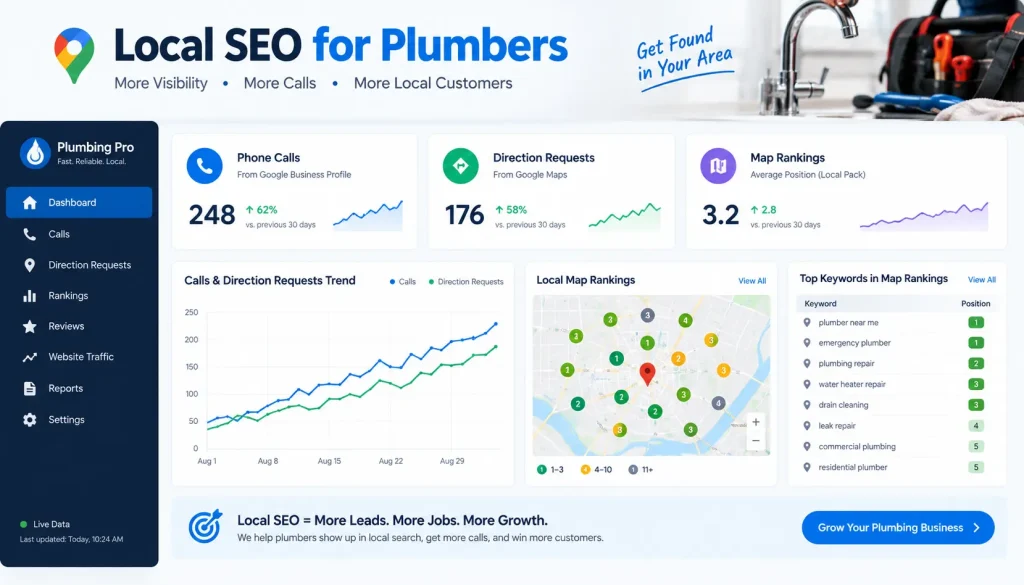
Website traffic alone does not pay the bills. Track the numbers that connect to jobs:
| Metric | Where to Find It | Why It Matters |
| Calls from your profile | Business Profile performance data | Direct lead measure |
| Direction requests | Business Profile performance data | Shows local intent |
| Map pack position | Rank tracking tool or manual incognito check | Visibility measure |
| Website clicks and queries | Search Console | Shows what drives visits |
| Review count and rating | Profile and review platforms | Trust measure |
| Booked jobs from search | Your CRM or call log | Real return |
Ask every new customer how they found you and record the answer. It is the most honest attribution you will get.
Common Local SEO Mistakes Plumbers Make
• Keyword stuffing the business name. Adding “Best Cheap Plumber Near Me” to your profile name violates guidelines and can get the profile suspended.
• Inconsistent contact details. Different phone numbers or name formats across the web.
• Ignoring reviews. Leaving feedback unanswered for months.
• Listing too many service areas. Claiming 40 towns you rarely reach.
• Duplicate location pages. Identical text with swapped city names.
• No clear call to action. Burying the phone number.
• Neglecting mobile. Slow, cluttered pages on phones.
• Never updating the profile. No new photos, posts or hours updates.
• Chasing rankings and ignoring the phone. Great visibility, poor call handling.
A 30 Day Action Plan
Week 1: Foundation
• Claim and verify your Google Business Profile
• Set the right categories, hours, service areas and description
• Upload at least 15 real photos
Week 2: Consistency
• Audit citations and fix name, address and phone differences
• Add the major directories you are missing
Week 3: Website
• Build or improve service pages
• Add click to call, schema and a fast mobile experience
Week 4: Trust and Content
• Start the review request routine
• Publish your first two helpful guides
• Set up tracking for calls and rankings
After that, repeat monthly: new reviews, new photos, one new page or guide, one local link or mention.
Frequently Asked Questions
What is local SEO for plumbers?
It is the process of optimizing your Google Business Profile, website, citations and reviews so your plumbing company appears in map results and local searches when nearby customers need help.
How long does local SEO take to work for a plumber?
Profile improvements can show movement in a few weeks, while stronger rankings often take three to six months depending on competition and your starting point.
Is a Google Business Profile enough on its own?
No. It is the foundation, but a supporting website with service pages, consistent citations and good reviews strengthens relevance and prominence.
How many reviews does a plumber need to rank?
There is no fixed number. Aim to match or beat the top competitors in your area for both count and recency, and keep a steady flow of new ones.
Should I list my home address?
If you do not serve customers at your address, you can hide it and set up as a service area business. Follow Google’s guidelines and keep information accurate.
Do I need separate pages for every city I serve?
Create pages for the places that matter most to your business, and make each page genuinely useful with local details. Skip thin pages for towns you rarely serve.
What is the difference between SEO and paid ads for plumbers?
Ads deliver leads immediately but stop when you stop paying. Local SEO takes longer but builds lasting visibility that keeps producing calls.
Can I do plumber SEO myself?
Yes. The profile, reviews and basic website fixes are very doable for an owner. Hire help when you want to scale content, links and technical work.
Your Next Step
Open your Google Business Profile today and compare it with the checklist above. Fix the categories, hours and photos first, then start asking every finished job for a review. Those two moves alone often create the first visible lift. If you want help planning the rest, you can reach out through our contact page and we can look at your listing together.